
Few things are more frustrating than building a website, waiting weeks or months, and seeing little to no movement in Google search results. If you’ve searched for SEO services in Pakistan, hoping to finally diagnose the problem, here is a clear, honest breakdown of the most common reasons websites fail to rank, along with what actually fixes each one.
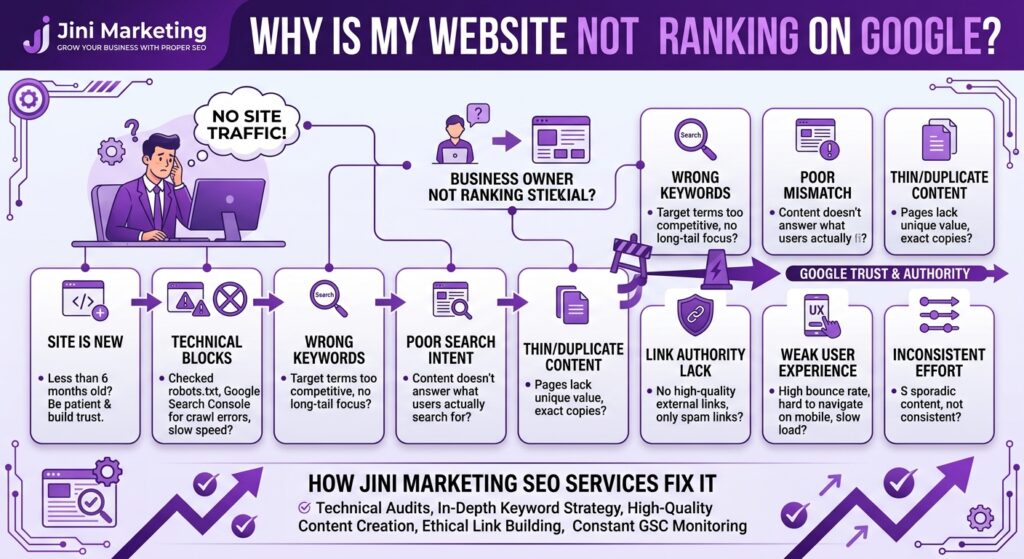
Reason 1: Your Site Is Too New
Google needs time to discover, crawl, and build trust in a new website. This is often called the “sandbox effect,” though it is more accurately just the natural process of a new domain earning authority. If your site is under 6 months old, limited rankings may simply reflect normal early-stage timing rather than something being fundamentally wrong.
The Fix: Patience combined with consistent, genuine effort. There is no shortcut around building initial trust, but consistent quality work during this period sets up faster growth once the foundation is established.
Reason 2: Technical Issues Are Blocking Google
Sometimes the content is fine, but technical problems prevent Google from properly crawling or indexing your pages in the first place. Common culprits include:
- Accidental “noindex” tags left on pages, telling Google not to index them at all
- Robots.txt blocking important pages from being crawled
- Broken internal links preventing Google from discovering all your content
- Extremely slow page speed, which can hurt both crawling efficiency and rankings directly
- Poor mobile experience, especially damaging since Google primarily uses mobile-first indexing
The Fix: A technical audit is the essential first step here. Checking Google Search Console for crawl errors, indexing status, and any manual actions is where any diagnosis should start.
Reason 3: You’re Targeting the Wrong Keywords
Many websites don’t rank simply because they are targeting keywords that are either too competitive for their current authority level, or too disconnected from what their actual audience searches for.
The Fix: Proper keyword research matched to your site’s realistic current authority level. Starting with more achievable, specific long-tail keywords before competing for broader, harder terms is usually the smarter path.
Reason 4: Your Content Doesn’t Actually Satisfy Search Intent
Even well-written content fails to rank if it doesn’t match what someone searching that term actually wants. For example, if someone searches “how to fix a leaking tap” expecting a step-by-step guide, but your page is a sales pitch for plumbing services, Google recognizes the mismatch and won’t rank it well for that search.
The Fix: Study the current top-ranking results for your target keyword and understand what format and depth of content is actually satisfying that search intent, then create something genuinely better.
Reason 5: Thin or Duplicate Content
Pages with very little unique content, or content that closely duplicates other pages (either on your own site or elsewhere on the web), struggle to rank because Google has little unique value to reward.
The Fix: Consolidate thin pages into more comprehensive resources, and ensure every page offers genuinely unique value rather than rehashing content that exists elsewhere.
Reason 6: No Backlinks (Or Only Low-Quality Ones)
Backlinks remain one of Google’s strongest trust signals. A site with no external websites linking to it, or only spammy, low-quality links, struggles to build the authority needed to rank, especially for competitive keywords.
The Fix: A genuine link-building strategy focused on earning relevant, quality backlinks over time, rather than either ignoring this factor entirely or resorting to risky shortcuts that can backfire.
Reason 7: Your Competitors Are Simply Stronger
Sometimes the honest answer is that your competitors have more established authority, more comprehensive content, and stronger backlink profiles. This means your current site, however good, is not yet competitive enough for that specific keyword.
The Fix: A realistic competitive analysis to understand exactly what is needed to close the gap, and a strategy built around gradually building comparable or superior authority over time.
Reason 8: Inconsistent or Abandoned Effort
Publishing a burst of content for a month, then going silent for the next six, sends weak signals to Google and fails to build the kind of sustained momentum that drives real ranking improvement.
The Fix: Consistency matters more than intensity. A steady, sustainable content and optimization schedule outperforms sporadic bursts of activity, even at a smaller monthly volume.
Reason 9: Poor User Experience Signals
Google increasingly factors in how real users interact with your site after clicking through from search results. If visitors quickly leave your page (a high “bounce” pattern) because it is confusing to navigate, loads slowly, or doesn’t match what they expected, this can signal to Google that your page isn’t satisfying searchers well, even if the content itself covers the right topic.
The Fix: Review your site’s actual user experience honestly. Is navigation clear? Does the page load quickly? Is the content easy to scan and find what someone is looking for? Sometimes a content problem is actually a design and usability problem in disguise.
Reason 10: You’re Not Tracking the Right Metrics to Even Know What’s Wrong
Some businesses aren’t ranking simply because they don’t have visibility into what is actually happening. They have no Search Console setup, no rank tracking, and no clear sense of which pages are performing versus which aren’t. Without this visibility, it is nearly impossible to diagnose or fix the real issue.
The Fix: Setting up proper tracking (Google Search Console at minimum, ideally paired with a rank tracking tool) isn’t optional groundwork. It is the foundation that makes every other fix on this list possible to properly evaluate.
How Long Should You Try Fixing This Yourself Before Getting Help?
There is no universally correct answer, but a reasonable framework exists. If you’ve addressed the more obvious items on this list (technical basics, content quality, some consistent effort) and given it a genuine 4 to 6 month runway without meaningful improvement, that is usually a fair point to seek a professional diagnostic rather than continuing to guess. Beyond that point, the cost of continued trial-and-error often exceeds what a proper audit and strategy would have cost from the start.
How to Actually Diagnose Your Specific Situation
Rather than guessing which of these applies to you, a proper diagnostic process typically includes:
- Checking Google Search Console for indexing status, crawl errors, and manual actions
- Reviewing your current rankings for target keywords to understand where you actually stand
- Analyzing top-ranking competitors for your target keywords to identify gaps in content depth or authority
- Auditing your backlink profile for both quantity and quality
- Testing site speed and mobile experience using free tools like Google PageSpeed Insights
If working through this diagnostic process feels overwhelming, this is exactly the kind of foundational audit that professional SEO services in Pakistan typically begin every new client relationship with, identifying the specific, real reasons behind stalled rankings rather than applying a generic fix.
Why “My Website Isn’t Ranking” Rarely Has One Single Cause
In most real cases, it’s not just one factor from this list, it’s usually a combination of two or three issues compounding together. A newer site with a few technical issues and thin content, for example, faces a harder climb than a site with just one of those problems in isolation. This is why a proper audit matters more than guessing at a single fix.
When to Get Professional Help
If you’ve addressed the obvious basics (technical health, content quality, some initial link building) and still aren’t seeing movement after several months, it’s often a sign that either your keyword targets are too ambitious for your current authority level, or there are technical issues not obvious without a deeper audit. At that point, working with an experienced provider of SEO services in Pakistan to get a proper diagnostic can save months of continued guessing.
Frequently Asked Questions
Why isn’t my new website ranking on Google yet?
New websites typically need time, often several months, for Google to build trust and authority in the domain. Limited early rankings are often simply a normal part of this timeline rather than a sign something is wrong.
Can technical issues prevent my website from ranking at all?
Yes. Issues like accidental noindex tags, robots.txt blocking important pages, or severe crawl errors can prevent Google from properly indexing your content, regardless of how good the content itself is.
Does content quality really affect Google rankings?
Significantly. Content that doesn’t genuinely satisfy what a searcher is looking for struggles to rank well, even if it’s well-written, because Google prioritizes matching actual search intent.
How important are backlinks for ranking on Google?
Very important. Backlinks remain one of Google’s strongest trust and authority signals, and sites with few or low-quality backlinks often struggle to rank for competitive keywords.
Can targeting the wrong keywords be why my site isn’t ranking?
Yes, this is a very common issue. Targeting keywords too competitive for your site’s current authority level often means little visible progress despite genuine effort elsewhere.
How long should I wait before assuming something is wrong with my SEO?
Generally, give a new strategy at least 4 to 6 months before assuming something is fundamentally wrong, since SEO naturally takes time. If there has been zero measurable progress after that period, a deeper diagnostic is worthwhile.
Does inconsistent content publishing hurt my rankings?
Yes. Sporadic bursts of activity followed by long gaps send weaker signals than steady, consistent publishing, even at a smaller but sustained monthly volume.
How do I check if Google has indexed my website properly?
Google Search Console shows your indexing status directly, including any pages excluded from the index and the reasons why, making it the best starting point for diagnosis.
Can my competitors be the reason I’m not ranking, even with good SEO?
Yes. Sometimes competitors simply have stronger existing authority and content depth, meaning closing that gap requires a sustained strategy rather than a quick fix.
Should I hire a professional to diagnose why my site isn’t ranking?
If you’ve addressed obvious basics without improvement after several months, a professional audit can often identify deeper technical or strategic issues that aren’t obvious without specialized tools and experience.