
This is one of the most honest questions a business owner can ask before spending money, and it deserves an honest answer, not just a sales pitch. Before committing budget to SEO services in Pakistan, it’s worth genuinely understanding whether SEO fits your specific business or whether your money might be better spent elsewhere, at least for now.
What SEO Actually Does for a Business
At its core, SEO helps your website appear when potential customers search for things related to what you offer without paying for each click the way advertising requires. Instead of interrupting someone’s attention (like an ad might), SEO positions your business to be found exactly when someone is already actively looking.
This matters because search-driven traffic tends to convert well someone searching “best SEO services in Pakistan” or “affordable dentist near me” already has clear intent, unlike someone scrolling past a social media ad with no immediate need in mind.
Signs Your Business Genuinely Needs SEO
People are searching for what you offer. If your product or service is something people actively search for on Google even a modest volume there’s an opportunity being left on the table without SEO.
Your competitors are already ranking. If a quick Google search for your industry shows competitors appearing prominently while you’re nowhere to be found, that visibility gap represents real customers going to them instead of you.
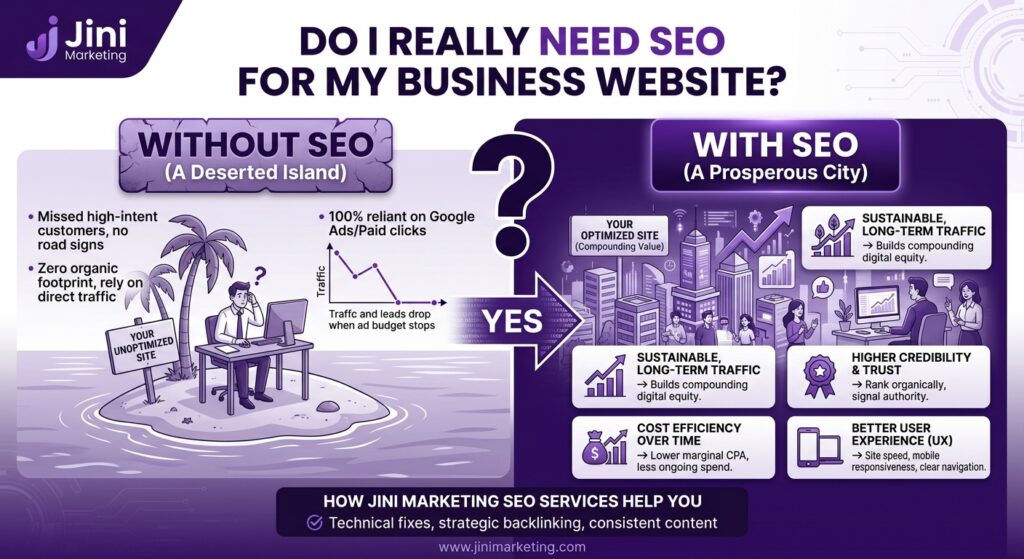
You want sustainable, long-term customer acquisition. Unlike paid ads that stop the moment you stop paying, SEO builds an asset that continues generating traffic over time, making it a genuinely different kind of investment than pay-per-click spending.
Your business model depends on discovery. If customers need to actively find you (rather than already knowing your brand from word-of-mouth or existing relationships), search visibility becomes a much more central part of your growth strategy.
When SEO Might Not Be Your Priority Right Now
Being honest, SEO isn’t automatically the right first investment for every business at every stage:
If you’re pre-revenue or extremely early-stage, validating your product or service with any customers at all often matters more than optimizing for search visibility you don’t yet have proven demand for.
If your business relies entirely on referrals or existing relationships, and search discovery isn’t how customers typically find businesses like yours, other marketing channels may offer faster, more directly relevant returns.
If you have zero budget flexibility, it’s worth knowing that SEO takes months to show meaningful results if you need revenue immediately, a channel with faster turnaround (like paid ads or direct outreach) may need to come first, with SEO added once initial cash flow stabilizes.
If nobody is actually searching for what you offer, which happens with some highly novel products or services, SEO can’t create demand that doesn’t exist it captures existing search demand, it doesn’t invent it.
The Real Cost of Skipping SEO Entirely
Even if SEO doesn’t feel urgent right now, it’s worth understanding what skipping it long-term actually costs: every month your competitors build search visibility while you don’t, the gap widens, and catching up later becomes progressively harder and more expensive than starting consistently now. This doesn’t mean every business needs to start immediately but it does mean the “wait and see” approach has a real, compounding cost attached to it.
How to Test Whether SEO Makes Sense Before Committing Fully
If you’re still unsure, a few low-risk ways to validate demand before a full commitment:
- Search your own industry keywords yourself and see what kind of businesses are currently ranking are they comparable to yours, or dramatically more established?
- Use a free keyword research tool to check actual search volume for terms related to your business surprisingly low volume might suggest limited immediate opportunity.
- Talk to existing customers about how they typically search for businesses like yours, if search plays a role at all in their decision-making process.
- Start with a smaller-scope engagement rather than a full enterprise package, to validate the channel works for your specific business before scaling investment.
Providers offering SEO services in Pakistan can often help with this kind of initial validation as part of a preliminary consultation, before you commit to a larger ongoing engagement.
SEO as a Long-Term Asset, Not Just a Marketing Expense
One useful mental shift: rather than thinking of SEO purely as a monthly marketing expense, think of it as building a long-term business asset similar to how a physical storefront in a good location retains value over years, well-executed SEO continues generating value long after the initial investment, unlike ad spend that produces zero ongoing return once paused.
This framing helps clarify why SEO often makes sense even for businesses not in immediate financial urgency it’s less about solving this month’s revenue problem and more about building a durable, compounding channel for the years ahead.
Making the Decision for Your Specific Business
Ultimately, the “do I need SEO” question comes down to a few honest factors: is there real search demand for what you offer, are your competitors already capturing that demand, and do you have the runway (both time and budget) to invest in a channel that builds value gradually rather than instantly? If the answer to these leans positive, investing in proper SEO services in Pakistan is very likely to pay off over a reasonable timeframe. If not, it may simply be a “not yet” rather than a permanent “no.”
Frequently Asked Questions
Does every business need SEO?
Not necessarily immediately, but most businesses benefit eventually if their customers use search engines to find products or services like theirs. The urgency depends on your industry, competition, and current growth stage.
How do I know if SEO is worth it for my specific business?
Check whether people actively search for what you offer, whether competitors are already ranking well, and whether you have the budget runway to wait for SEO’s typically gradual timeline to pay off.
Is SEO better than paid advertising for a new business?
Neither is universally better paid ads offer faster, more immediate visibility, while SEO builds longer-term, more sustainable value. Many businesses benefit from using both at different stages.
Can a small business survive without doing SEO?
Yes, especially if the business relies heavily on referrals, existing relationships, or other marketing channels where customers aren’t primarily discovering the business through search.
What happens if I never invest in SEO for my business? Competitors who do invest gradually capture more search visibility over time, making the gap harder and more expensive to close the longer it’s left unaddressed.
Is SEO a one-time investment or ongoing expense?
SEO is generally an ongoing investment, since search rankings require continued maintenance and competition means standing still often means gradually losing ground to competitors actively investing.
How much does it cost to find out if SEO would work for my business?
Basic validation searching your own industry keywords and checking search volume with free tools costs nothing. A preliminary consultation with an SEO provider is also typically low-cost or free before committing to a larger package.
Does SEO work for very niche or unusual businesses?
It depends on whether people actually search for that niche online. If there’s genuine, even modest, search demand, SEO can work; if the concept is so novel that no one is searching for it yet, other marketing approaches may be more effective initially.
Should a brand-new business start with SEO immediately?
Not always — very early-stage businesses often benefit more from validating their product or service first, then adding SEO as a growth channel once initial demand is confirmed and cash flow allows for the investment.
How long before I know if SEO was the right decision for my business?
Most businesses can evaluate early signals (search console data, initial ranking movement) within 3-4 months, with a clearer overall picture typically forming by month 6.