
If you’ve spent any time researching SEO services in Pakistan, you’ve likely come across the terms “white hat” and “black hat” SEO. Understanding the difference isn’t just academic: it’s the difference between a strategy that builds sustainable long-term growth and one that can get your entire website removed from Google search results.
Here is a clear breakdown of both approaches, and why the choice matters more than most business owners realize.
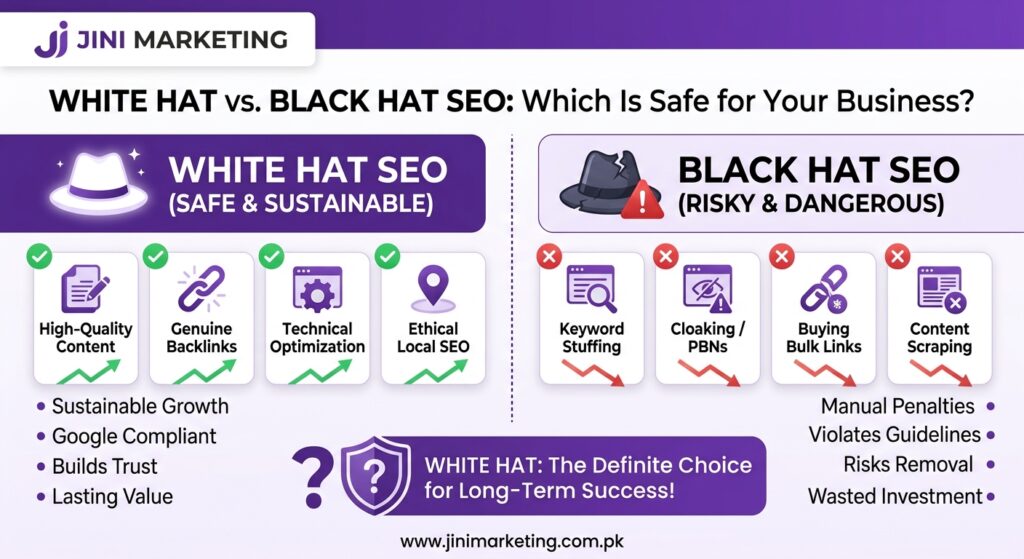
What White Hat SEO Actually Means
White hat SEO refers to optimization techniques that follow Google’s official webmaster guidelines. Essentially, this means playing by the rules Google has publicly established for what constitutes legitimate, helpful optimization.
White hat techniques include:
- Creating genuinely useful, original content that answers real questions your audience has
- Earning backlinks naturally through quality content, relationships, and legitimate outreach
- Proper technical optimization, improving site speed, mobile-friendliness, and crawlability
- Accurate, honest on-page elements, including title tags and descriptions that genuinely reflect page content
- Ethical local SEO practices, accurate business information, and genuine customer reviews
The trade-off is that white hat SEO takes longer to show results, since it is built on genuinely earning trust and authority rather than shortcuts.
What Black Hat SEO Actually Means
Black hat SEO refers to techniques that violate Google’s guidelines, typically attempting to manipulate rankings through shortcuts rather than genuine value. These techniques carry real risk of penalties.
Common black hat techniques include:
- Keyword stuffing, unnaturally cramming keywords into content in ways that read awkwardly and provide no real value to readers
- Cloaking, showing different content to search engines than to actual human visitors
- Private blog networks (PBNs), networks of low-quality sites created solely to artificially inflate backlink counts
- Buying links in bulk, purchasing large quantities of low-quality backlinks purely for volume, rather than earning them through genuine relevance
- Hidden text or links, text or links invisible to human visitors but readable by search engines, designed to manipulate rankings deceptively
- Content scraping, copying content from other sites without meaningful original value added
Why Black Hat SEO Is Genuinely Risky
The appeal of black hat SEO is obvious, as it often promises faster results at lower cost. But the risk is severe:
- Manual penalties. Google’s team can manually review and penalize sites found using manipulative techniques, sometimes removing them from search results entirely.
- Algorithmic penalties. Google’s automated systems (like historical updates such as Penguin, targeting link spam) can detect and penalize manipulative patterns at scale, without any human review triggering it.
- Difficult, slow recovery. Recovering from a penalty often takes far longer than the time it took to get penalized in the first place, sometimes months of cleanup work, disavowing bad links, and rebuilding trust with Google.
- Wasted investment. Any short-term gains from black hat tactics are typically erased entirely once a penalty hits, along with the money spent getting there.
A Middle Ground: “Gray Hat” SEO
Some techniques fall into an ambiguous middle ground. They are not clearly against Google’s guidelines, but pushing the boundaries of what is considered fully legitimate. Examples include aggressive guest posting purely for links (rather than genuine content contribution) or slightly exaggerated content designed primarily to rank rather than genuinely inform. While gray hat tactics carry lower immediate risk than clear black hat techniques, they still represent a less sustainable long-term strategy than fully white hat approaches.
How to Tell Which Approach Your SEO Provider Uses
This is one of the most important things to clarify before hiring any agency offering SEO services in Pakistan. A few direct questions help:
- “Do you follow Google’s official webmaster guidelines?”
- “Where do your backlinks come from, specifically?”
- “Can you explain your content creation process?”
- “Have any of your past clients experienced a Google penalty?”
Vague, evasive, or overly confident answers (“don’t worry about it, just trust us”) are a warning sign. A legitimate provider should be able to explain their approach clearly and confidently, without dodging specifics.
Why White Hat SEO Is Almost Always the Right Choice
Even though it takes longer, white hat SEO is the far safer investment for almost every business, because:
- It builds lasting value rather than gains that can vanish instantly with a penalty
- It protects your brand reputation, since a Google penalty can be publicly visible and damaging beyond just lost traffic
- It compounds over time, meaning the longer you invest in it, the stronger your results tend to become
- It aligns with how search engines are actually evolving, Google’s algorithms have become increasingly sophisticated at detecting manipulation over time, making black hat tactics riskier with each passing year
If you are evaluating providers of SEO services in Pakistan and want to confirm you are working with a genuinely white-hat approach, ask directly about their process and don’t hesitate to walk away from vague or evasive answers.
How Google’s Approach to Detecting Manipulation Has Evolved
It is worth understanding that black hat SEO has become progressively riskier over the years, not less. Google’s algorithms have grown increasingly sophisticated at detecting patterns that once went unnoticed. Techniques that may have worked years ago are now far more likely to be caught, sometimes retroactively penalizing sites for tactics used long before detection improved. This trend makes betting on black hat SEO an increasingly poor long-term wager, even for businesses tempted by faster short-term results.
Additionally, Google has increasingly emphasized genuine expertise, experience, authoritativeness, and trustworthiness (often referred to as E-E-A-T principles) in how it evaluates content quality. This is a direction that inherently favors white hat approaches focused on genuine value over manipulation.
A Practical Checklist Before Starting Any SEO Engagement
Before signing on with any provider, regardless of how their pricing or pitch sounds, run through this quick checklist:
- Do they explain their content creation process clearly, including how they ensure originality and genuine usefulness?
- Can they describe specifically where backlinks will come from, rather than vague references to “our network”?
- Are they realistic about timelines, or do they promise unusually fast results?
- Do they mention following Google’s official guidelines without being prompted?
- Are they transparent about risks involved in any technique they are proposing?
A provider who checks these boxes confidently is far more likely to be building your SEO on a genuinely sustainable, white-hat foundation.
What to Do If You Suspect Your Current SEO Provider Uses Black Hat Tactics
If you are already working with someone and have concerns:
- Ask directly where backlinks are coming from and request a list if possible.
- Check Google Search Console for any manual action notifications, which would indicate an existing penalty.
- Review your backlink profile using free tools to spot obviously spammy or irrelevant sites linking to you.
- Consider a second opinion from another provider to audit the current approach objectively.
Catching risky practices early, before a penalty hits, is far easier and cheaper than recovering after the damage is done. A proper audit from an experienced team offering SEO services in Pakistan can usually spot warning signs quickly.
Frequently Asked Questions
What’s the difference between white hat and black hat SEO?
White hat SEO follows Google’s official guidelines using legitimate, sustainable techniques, while black hat SEO uses manipulative shortcuts that violate those guidelines and risk severe penalties.
Can black hat SEO get my website removed from Google?
Yes. Google can apply manual or algorithmic penalties that significantly reduce visibility or remove a site from search results entirely when manipulative techniques are detected.
Is black hat SEO ever worth the risk?
Generally no. Any short-term gains are typically erased once a penalty hits, and recovery often takes far longer and costs more than the original investment in legitimate SEO would have.
How do I know if my SEO agency is using black hat techniques?
Ask directly where their backlinks come from and how content is created. Vague answers, unusually fast promised results, or reluctance to explain their process are warning signs.
What is gray hat SEO?
Gray hat SEO refers to techniques that aren’t clearly against Google’s guidelines but push ethical boundaries, such as aggressive link-building tactics that prioritize volume over genuine relevance.
How long does it take to recover from a Google penalty?
Recovery timelines vary widely depending on severity, but they often take several months of cleanup work, including disavowing bad links and rebuilding trust signals with Google.
Does white hat SEO take longer to show results than black hat SEO?
Yes, typically. White hat SEO builds genuine authority over time, which takes longer than manipulative shortcuts — but it doesn’t carry the same risk of penalties erasing your progress.
Can I check if my website already has a Google penalty?
Yes, Google Search Console shows manual action notifications if your site has received a penalty. Reviewing this regularly is a good practice regardless of who manages your SEO.
Are paid backlinks always black hat?
Purchasing backlinks specifically to manipulate rankings violates Google’s guidelines, though there are legitimate paid placements (like sponsored content clearly marked as such) that differ from manipulative link-buying schemes.
Why do some SEO agencies still use black hat techniques despite the risk?
Black hat tactics can produce faster short-term results at lower effort, which appeals to agencies prioritizing quick wins over sustainable, long-term client relationships — a trade-off that usually backfires eventually.