
Starting a new business in Pakistan comes with a long list of urgent priorities funding, product, hiring, operations. Marketing budgets are often tight, and every rupee needs to justify itself. So when SEO comes up as an option, a common question follows: is it actually worth investing in SEO this early, or should a startup focus on faster channels like paid ads and social media first?
This article breaks down exactly when SEO makes sense for a new business, what to realistically expect, and how to approach it without wasting your limited early-stage budget.
The Short Answer
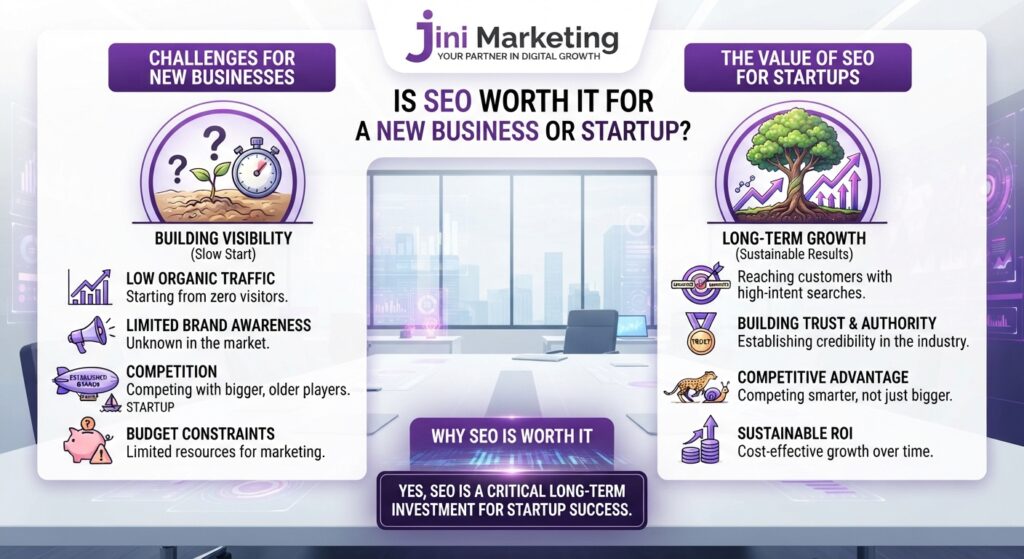
Yes, SEO is worth it for most new businesses and startups in Pakistan but the way you approach it needs to match your stage, budget, and industry. SEO isn’t a quick win, but it’s one of the few marketing channels that compounds over time instead of stopping the moment you stop paying for it.
That said, SEO should rarely be your only channel in the first few months. It works best alongside other efforts while it builds momentum in the background.
Why SEO Matters Especially for New Businesses
1. It Builds a Long-Term, Sustainable Asset
Unlike paid advertising, where traffic disappears the moment your budget runs out, SEO builds equity in your website over time. A well-optimized page you publish today can keep bringing in customers a year from now without any additional ad spend. For cash-strapped startups, this compounding effect is incredibly valuable.
2. It Captures High-Intent Customers
People searching Google for specific solutions “best SEO company in Rawalpindi” or “affordable web hosting Pakistan” are actively looking to buy or hire. That’s fundamentally different from someone scrolling past a social media ad. Ranking for these searches means you capture customers who are already looking for exactly what you offer.
3. It Builds Trust and Credibility
Pakistani consumers, like most people globally, tend to trust businesses that show up organically on Google over businesses they only see in ads. Appearing on page one especially in the map pack or organic results signals legitimacy, which matters enormously for a brand-new business with no reputation yet.
4. It’s More Cost-Effective Long-Term Than Paid Ads
Paid ads can get expensive fast, especially in competitive industries. While SEO requires upfront investment in strategy and content, the cost per customer acquired through organic search tends to decrease significantly over time as your rankings improve something paid ads simply can’t replicate.
The Honest Trade-Offs You Need to Know
SEO Takes Time
This is the biggest trade-off. Most new websites need 4 to 8 months before seeing significant organic traffic growth, and competitive keywords can take even longer. If you need customers next week, SEO alone won’t get you there you’ll need paid ads or direct outreach in the meantime.
You’re Starting From Zero Authority
A brand-new domain has no backlinks, no history, and no trust signals with Google yet. This means early-stage SEO work is partly about building that foundation before you can compete for harder keywords.
It Requires Consistency
SEO isn’t a one-time project. It needs ongoing content, technical maintenance, and link building to keep gaining ground, especially against competitors who are also investing in SEO Services in Pakistan.
How Startups Should Approach SEO Differently Than Established Businesses
Start With Low-Competition, High-Intent Keywords
Instead of chasing broad, highly competitive terms right away, new businesses should target specific, lower-competition long-tail keywords first. These are easier to rank for and often convert better because they match very specific customer intent.
Prioritize Technical Foundations Early
Since you’re building a new website, this is the perfect time to get the technical SEO right from day one proper site structure, fast loading speed, mobile responsiveness, and clean URLs. Fixing these issues later, after your site has grown, is far more expensive and time-consuming.
Invest in Local SEO If You Serve a Specific City
If your startup serves customers in a specific location say, a service business in Karachi or a clinic in Islamabad local SEO can produce results faster than competing nationally. Setting up and optimizing your Google Business Profile early is one of the highest-ROI moves a new business can make.
Combine SEO With Paid Ads During the Growth Phase
Many successful startups run paid ads for immediate traffic and leads while SEO builds momentum in the background. Once organic rankings start delivering consistent traffic, you can often reduce ad spend and let SEO carry more of the load significantly lowering your customer acquisition cost over time.
What a Realistic SEO Timeline Looks Like for a Startup
- Months 1–2: Technical audit, keyword research, website foundation setup, Google Business Profile optimization
- Months 2–4: Content publishing begins, on-page optimization rolled out, early link building starts
- Months 4–6: First meaningful ranking improvements for long-tail keywords, gradual traffic increase
- Months 6–12: Increased visibility for competitive keywords, steady organic lead flow, stronger domain authority
Agencies experienced with early-stage businesses, such as the team behind Jini Marketing’s SEO Services in Pakistan, typically build a phased roadmap specifically for startups rather than applying the same strategy used for established enterprise clients.
Common Mistakes Startups Make With SEO
- Expecting instant results and abandoning SEO after just one or two months
- Targeting only highly competitive keywords that are unrealistic for a brand-new site
- Ignoring technical SEO in favor of just publishing content
- Skipping local SEO even when serving a specific city or region
- Choosing the cheapest agency without checking their actual process or past results
- Treating SEO as a one-time expense rather than an ongoing investment
When SEO Might Not Be the Right First Priority
There are some scenarios where SEO shouldn’t be a startup’s first move:
- If you need revenue immediately and have zero cash runway, paid ads or direct sales will likely deliver faster results
- If your product or service is extremely niche with almost no search volume, other channels like partnerships or outreach might work better initially
- If your website isn’t ready yet (still being built or heavily revised), it makes sense to wait until it’s stable before investing heavily in SEO
Even in these cases, it’s smart to at least handle the technical foundations early so you’re SEO-ready the moment you’re able to invest more seriously.
Calculating the Real ROI of SEO for a Startup
Founders naturally want to know: what’s the actual return on this investment? Unlike paid ads, where cost-per-click and conversion rate give you an immediate ROI picture, SEO’s return builds gradually and needs to be evaluated differently.
To estimate SEO’s value for your startup, consider:
- Customer lifetime value (LTV): Even a small number of organic leads per month can be extremely valuable if your average customer generates repeat revenue over time.
- Cost per acquisition compared to paid channels: Track how much you’re currently paying per lead through ads, then compare that to your monthly SEO investment divided by leads generated once the campaign matures.
- Compounding traffic value: A blog post or landing page that ranks well can keep generating leads for years with minimal additional investment, unlike an ad campaign that stops the moment you stop paying.
Most startups find that while the upfront cost per lead through SEO is higher in the first few months, it drops significantly below paid advertising costs once rankings stabilize often becoming the most cost-efficient channel within the first year.
Industry-Specific Considerations for Pakistani Startups
Different industries face very different SEO landscapes in Pakistan, and startups should factor this into their strategy:
E-commerce startups face intense competition for product-related keywords and need strong technical SEO, fast page speeds, and structured data for product listings to compete effectively.
Service-based startups (consulting, agencies, healthcare, legal) tend to benefit heavily from local SEO and long-tail, intent-driven keywords, since customers often search for specific problems rather than broad service categories.
SaaS and tech startups typically need strong content marketing focused on educational, problem-solving content, since much of their audience is researching solutions before they even know which specific product to buy.
Retail and hospitality startups benefit enormously from Google Business Profile optimization and review generation, since local map pack visibility often drives more walk-in traffic than organic website rankings alone.
Understanding which category your startup falls into helps determine where to prioritize limited early-stage SEO budget for the fastest possible impact.
Building an In-House Understanding, Even If You Outsource
Even if you hire an agency to handle execution, founders benefit enormously from understanding SEO basics themselves. This doesn’t mean becoming a technical expert it means being able to:
- Understand what questions to ask your agency
- Recognize whether reported progress makes sense
- Make informed decisions about budget allocation between SEO and other channels
- Communicate your business priorities clearly so your SEO strategy actually aligns with your goals
Founders who stay engaged with their SEO strategy, rather than treating it as a black box, consistently get better results from their agency relationships because the strategy stays aligned with real business priorities as the company evolves.
Signs Your Startup Is Ready to Invest Seriously in SEO
Not every startup is ready for SEO on day one, but certain signals suggest the timing is right:
- Your website and core offering are stable, not undergoing constant major changes
- You have at least a small, consistent marketing budget you can commit to for 6+ months
- You’ve validated product-market fit and understand who your ideal customer actually is
- You’re already seeing some traction through other channels and want to diversify beyond paid ads
- Your competitors are visibly investing in content and rankings, and you’re losing visibility to them
If most of these apply to your startup, it’s a strong signal that SEO investment will compound effectively rather than being wasted on a business still finding its footing.
Final Thoughts
For most new businesses and startups in Pakistan, SEO is absolutely worth the investment but it needs to be approached with realistic expectations and the right sequencing. Start with a strong technical foundation, target achievable keywords, prioritize local SEO if relevant, and be patient with the timeline. The businesses that commit to SEO early and stay consistent are usually the ones dominating their market 12 to 18 months down the line, while competitors still relying solely on paid ads keep paying for every single visitor.
If you’re a startup wondering where to begin, working with a specialized provider of SEO Services in Pakistan like Jini Marketing can help you build a phased strategy that fits your budget and growth stage.
Frequently Asked Questions
1. Is SEO worth it for a brand-new business in Pakistan?
Yes, SEO is worth it for most new businesses because it builds long-term, compounding traffic that doesn’t disappear when you stop spending, unlike paid ads.
2. How long does SEO take to work for a new website?
New websites typically start seeing meaningful organic traffic growth within 4 to 8 months, depending on competition, industry, and consistency of effort.
3. Should a startup do SEO or paid ads first?
Most successful startups run both simultaneously paid ads for immediate traffic and leads, while SEO builds sustainable, lower-cost traffic in the background.
4. How much should a startup budget for SEO in Pakistan?
Budgets vary based on industry competition and goals, but startups should expect to invest consistently over at least 6 to 12 months to see meaningful results.
5. Can a new business rank on Google’s first page quickly?
It’s possible for low-competition, long-tail keywords, but competitive industry terms typically take longer for a brand-new domain with no existing authority.
6. Is local SEO important for a new business?
Yes, especially if the business serves a specific city or region. Local SEO, including Google Business Profile optimization, often delivers faster results than national SEO campaigns.
7. What’s the biggest SEO mistake new businesses make?
Expecting instant results and abandoning the strategy too early, usually within the first one or two months, before SEO has had time to work.
8. Do startups need a big budget to start SEO?
No, startups can begin with foundational technical SEO and targeted long-tail keywords on a modest budget, then scale investment as the business grows.
9. Should I wait until my startup is more established before doing SEO?
No, it’s actually more cost-effective to build SEO foundations early, since fixing technical and structural issues later is more expensive and time-consuming.
10. Where can startups get affordable, results-focused SEO services in Pakistan?
Providers like Jini Marketing offer tailored SEO Services in Pakistan designed specifically for new businesses and startups working with limited budgets.