
If you’re a small or medium business watching much larger competitors dominate Google’s search results, it’s natural to wonder whether investing in SEO services in Pakistan could actually make a meaningful difference or whether you’re simply outgunned by their bigger budgets. The honest answer is more encouraging than you might expect, with some important nuance.
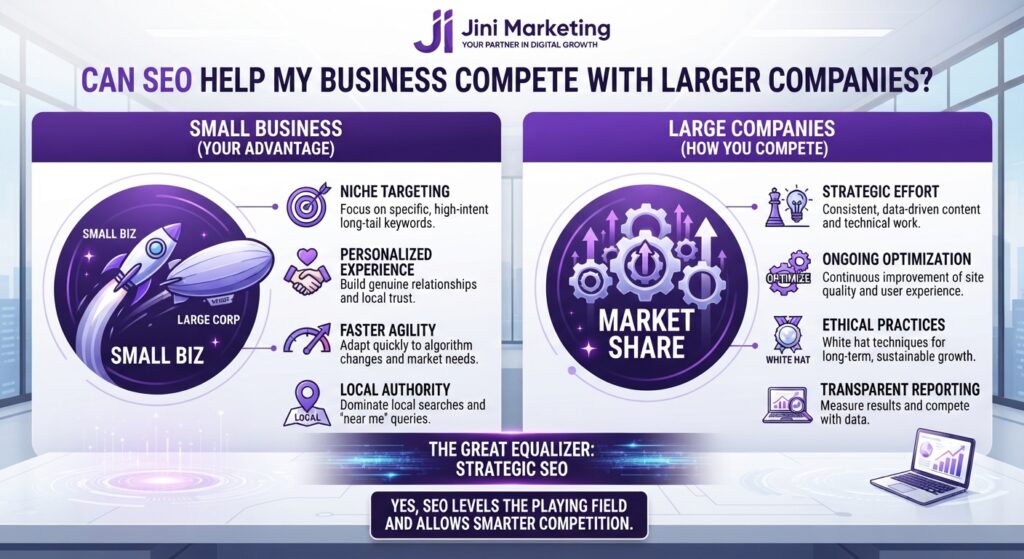
Why SEO Genuinely Levels the Playing Field (More Than Most Marketing Channels)
Unlike advertising, where the business with the biggest budget can often simply outspend smaller competitors for visibility, SEO rewards relevance, quality, and genuine usefulness factors that don’t scale purely with company size or marketing budget.
A well-optimized page from a small business, genuinely answering a specific customer question better than a large competitor’s generic page, can and often does outrank that larger competitor for that specific search term. Google’s ranking system, while not perfect, is fundamentally built around rewarding the most relevant, useful result — not simply the biggest brand name.
Where Small Businesses Have a Genuine Advantage
Niche specificity. Large companies often create broad, generic content trying to serve everyone, while a small business can create deeply specific, genuinely expert content around their particular niche content that often satisfies a specific searcher’s intent far better.
Agility. Smaller businesses can often respond to new keyword opportunities, algorithm changes, or emerging customer questions faster than large companies bogged down by internal approval processes and bureaucracy.
Local relevance. For location-based searches, a genuinely local business often has natural advantages (physical presence, authentic local reviews, community relationships) that a large national or international competitor simply can’t replicate as convincingly.
Authentic expertise. Google increasingly favors content demonstrating genuine, first-hand expertise and experience something a small business owner deeply familiar with their specific industry can often convey more authentically than generic corporate content produced by a large company’s marketing department.
Where Larger Companies Do Have Real Advantages
To be fair and realistic, larger companies typically have some genuine structural advantages worth acknowledging:
More resources for content volume. They can often produce and publish significantly more content, covering more keywords across a broader range of topics simultaneously.
Established domain authority. Years of accumulated backlinks and brand recognition give larger, established sites a head start that takes time for newer or smaller sites to match.
Bigger link-building budgets and networks. Larger companies often have more resources and existing relationships to acquire high-quality backlinks more easily.
Broader brand recognition, which can indirectly support SEO through increased branded searches and natural mentions across the web.
How Smart SEO Strategy Accounts for This Reality
The key isn’t pretending these advantages don’t exist it’s building a strategy that plays to your actual strengths rather than trying to directly out-muscle larger competitors on their own terms:
Target long-tail, specific keywords first. Rather than competing immediately for broad, highly competitive terms dominated by established players, focus on more specific, lower-competition phrases where genuine expertise and specificity can win faster.
Build topical authority in your specific niche. Rather than trying to cover everything the way a large company might, becoming the genuinely most comprehensive, useful resource within your specific specialty builds authority that’s harder for a generalist competitor to match.
Leverage local advantages if applicable. If your business has any local component, local SEO factors (Google Business Profile, local reviews, location-specific content) offer a genuine edge that larger, less locally-rooted competitors often can’t easily replicate.
Focus on genuine expertise and originality. Content reflecting real, first-hand experience and specific knowledge tends to perform better over time than generic, broadly-written content an area where a passionate small business owner or specialist team often has a real edge.
A Realistic Timeline for Competing With Larger Players
It’s worth being honest that competing with well-established, larger competitors typically takes longer than competing in a less crowded space often 8-12 months or more of consistent effort before meaningfully closing gaps for more competitive keywords. This is why choosing the right initial keyword targets (specific, achievable wins) rather than immediately chasing the most competitive terms matters so much for smaller businesses working with SEO services in Pakistan.
Real Examples of How This Plays Out
Consider a small, specialized law firm competing against a large national legal services company. The large company might rank well for broad terms like “lawyer in Pakistan,” but the small firm, by creating genuinely detailed, expert content around a specific practice area and city, can often outrank that same large competitor for more specific searches like “property dispute lawyer in Gulberg Lahore” a search that may have lower volume but far higher conversion likelihood for that specific business.
This pattern repeats across industries: smaller, more specific businesses often win on precision and relevance even when they can’t win on sheer content volume or domain authority.
Building a Strategy That Actually Works for Your Situation
Rather than assuming you either can or can’t compete with larger companies in the abstract, a proper strategy starts with honestly assessing where your genuine advantages lie (niche expertise, local presence, specific customer understanding) and building outward from there, rather than trying to directly replicate a larger competitor’s broad, resource-heavy approach. A provider offering SEO services in Pakistan with experience across different business sizes can help identify these specific opportunities for your situation.
Frequently Asked Questions
Can a small business really outrank a big company on Google?
Yes, particularly for specific, niche, or local search terms where relevance and specificity matter more than sheer content volume or domain authority. Broad, highly competitive terms remain harder to win quickly.
What SEO advantages do small businesses have over large companies?
Small businesses often have advantages in niche specificity, agility to respond to trends quickly, authentic local relevance, and genuine first-hand expertise that can be harder for larger, more generic competitors to replicate.
How long does it take a small business to compete with larger competitors in SEO?
This varies significantly by industry, but meaningfully closing competitive gaps typically takes 8-12 months or more of consistent, focused effort, especially for more competitive keyword categories.
Should a small business avoid competing for broad keywords entirely?
Not entirely, but starting with more specific, achievable long-tail keywords while gradually building authority is usually a smarter initial strategy than immediately targeting the most competitive broad terms.
Does local SEO help small businesses compete with national brands?
Yes, significantly. Local SEO factors like Google Business Profile optimization and genuine local reviews often give small, physically-present businesses a real advantage that larger, less locally-rooted competitors struggle to match.
Why do large companies still rank well despite less specific content?
Larger companies often benefit from established domain authority, accumulated backlinks over time, and broader brand recognition advantages built up over years that take time for smaller competitors to match.
Can content quality really beat a bigger marketing budget in SEO?
For specific, relevant searches, yes Google’s ranking system rewards genuine relevance and usefulness, which doesn’t scale purely with budget size, though budget does help with content volume and link-building speed.
What’s the best SEO strategy for a small business against big competitors?
Focus on niche-specific, long-tail keywords, build deep topical authority in your specialty, leverage any local advantages, and emphasize genuine expertise rather than trying to match a larger competitor’s broad content volume.
Does Google favor big brands over small businesses in search results?
Not inherently by brand size Google’s algorithm prioritizes relevance and quality signals, though larger brands often have accumulated advantages (backlinks, authority) that indirectly support stronger rankings over time.
Is it worth investing in SEO if my competitors are much bigger companies?
Yes, particularly if you focus your strategy on specific niches, local relevance, or underserved search terms where your size and specificity can actually work in your favor rather than against you.