
This is a natural question before investing in SEO Services in Pakistan—you want a sense of what you’re actually working toward. The honest answer is that it depends heavily on several specific factors, but understanding those factors helps you form a realistic, business-specific expectation rather than relying on generic industry claims.
Why There’s No Single Universal Answer
Traffic potential from SEO varies enormously based on your specific situation. A highly specific local service business and a broad national e-commerce store operate on completely different scales of realistic traffic growth. Any provider giving you a specific traffic number without understanding your industry, competition, and current site status is guessing rather than genuinely estimating.
Key Factors That Determine Your Realistic Traffic Potential
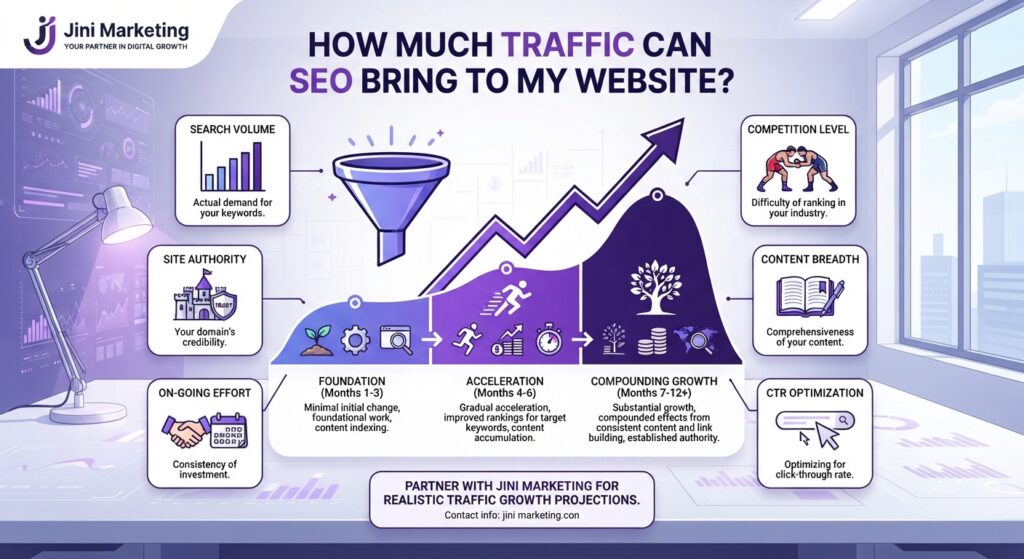
- Search volume for your relevant keywords: If very few people search for terms related to your business, even a number-one ranking won’t produce large traffic numbers. This is simply a function of actual demand, not a limitation of the SEO work itself.
- Competition level in your industry: Highly competitive industries require more sustained effort to achieve the rankings needed for meaningful traffic, while less competitive niches can often achieve strong visibility more efficiently.
- Your current site’s starting point: A newer site with limited existing authority typically takes longer to reach significant traffic levels compared to an established site with years of accumulated trust and backlinks.
- Breadth of your content strategy: A site targeting a narrow set of keywords will naturally see more limited traffic potential than one building comprehensive content across a broader relevant topic area.
- Consistency of ongoing investment: Traffic growth compounds with sustained effort over time. Sporadic or paused SEO work produces correspondingly inconsistent, slower traffic growth.
A Realistic Framework for Estimating Your Potential
Rather than a generic number, a more useful approach involves:
- Identifying your realistic target keywords based on actual search volume relevant to your business.
- Estimating achievable rankings for those keywords based on your industry’s competition level and your site’s growth trajectory.
- Applying realistic click-through rate expectations based on ranking position (top positions receive significantly more clicks than lower positions, even on the first page).
- Projecting this over a realistic timeline, accounting for the gradual nature of SEO growth rather than assuming immediate full traffic potential.
This kind of specific, data-grounded projection—rather than a generic industry-wide claim—is what a legitimate provider of SEO Services in Pakistan should be able to walk you through based on your actual business and keyword research.
What Traffic Growth Typically Looks Like Over Time
While exact numbers vary enormously by situation, a general pattern is often observed:
- Months 1-3: Minimal to modest traffic change, as foundational work is completed and initial content begins getting indexed.
- Months 4-6: Gradual, often accelerating traffic growth as rankings for initial keywords improve and additional content accumulates.
- Months 7-12: More substantial growth as compounding effects from consistent content and link building take fuller effect.
- Beyond 12 months: Continued growth, often at a steadier but still meaningful pace, assuming ongoing investment continues.
Businesses in less competitive niches sometimes see meaningful traffic growth faster than this general pattern suggests, while highly competitive industries may take longer to reach comparable relative growth. When planning long-term digital campaigns, working with experts providing reliable SEO Services in Pakistan helps set proper milestones for each of these phases.
Why Traffic Alone Isn’t the Full Picture
It’s worth emphasizing that raw traffic numbers matter less than qualified, relevant traffic that actually converts into business outcomes. A smaller amount of highly relevant, intent-driven traffic often produces more actual business value than a larger volume of loosely related visitors unlikely to become customers. This is why a good SEO strategy focuses on targeting keywords genuinely relevant to your business, not simply maximizing traffic volume for its own sai..
How to Set Realistic Traffic Goals for Your Business
Rather than adopting a generic industry benchmark, a more useful approach involves:
- Reviewing your current traffic baseline (if you have any existing site history) as your genuine starting point.
- Researching realistic search volume for keywords specifically relevant to your business and location.
- Setting incremental milestones (e.g., 20-30% growth by month six, continued growth by month 12) rather than a single distant target with no interim checkpoints.
- Adjusting expectations based on actual early data as your specific strategy develops and reveals real-world patterns unique to your situation.
Red Flags in Traffic Projections
Be cautious of any provider offering:
- Specific, guaranteed traffic numbers without having done genuine keyword research specific to your business first.
- Dramatically inflated projections that seem disconnected from your industry’s realistic search volume.
- No explanation of methodology behind how they arrived at a specific traffic estimate.
A trustworthy provider of SEO Services in Pakistan should be able to explain the reasoning behind any traffic projection they offer, grounded in actual keyword research and realistic competitive analysis specific to your business.
Making Traffic Projections Useful for Your Planning
Ultimately, the value of understanding realistic traffic potential isn’t about having an exact number to hold anyone strictly accountable to search behavior and competition shift over time—but about setting reasonable expectations for your budget planning and understanding roughly what scale of growth is achievable for your specific situation and industry.
Frequently Asked Questions
- How much website traffic can I expect from SEO?
This varies enormously based on your industry’s search volume, competition level, and your site’s current authority. There’s no universal number, though a proper keyword research process can provide a realistic, business-specific estimate. - How long does it take to see significant traffic growth from SEO?
Most businesses see modest early growth within 3-4 months, with more substantial, compounding growth typically building by months 7-12 of consistent effort. - Does a #1 Google ranking guarantee high traffic?
Only if there’s meaningful search volume for that specific keyword. A top ranking for a very low-search-volume term won’t produce significant traffic, regardless of the ranking position achieved. - Is more website traffic always better for my business?
Not necessarily. Relevant, intent-driven traffic that’s likely to convert into actual customers matters more than raw traffic volume, especially if that traffic doesn’t align well with what your business actually offers. - How can I estimate realistic traffic potential for my specific business?
Proper keyword research identifying actual search volume for terms relevant to your business, combined with realistic competitive analysis, provides a much more useful estimate than generic industry benchmarks. - Should I be suspicious of an SEO company promising specific traffic numbers?
Be cautious if they haven’t done genuine keyword research specific to your business first. Realistic projections should be grounded in actual data and explained methodology, not generic guarantees. - Does traffic growth from SEO continue after the first year?
Yes, typically, assuming ongoing investment continues. SEO growth often continues compounding over multiple years, particularly as accumulated content and backlinks continue providing value. - Can a small, niche business still get meaningful traffic from SEO?
Yes, particularly by targeting specific, relevant keywords well-matched to their niche, even if overall traffic volume is naturally smaller than what a broader, high-volume industry might achieve. - How does website age affect potential SEO traffic?
Older, more established sites often reach significant traffic levels faster than brand-new sites, since accumulated domain trust and authority support faster ranking improvements for new content. - What’s more important for traffic growth: content volume or content quality?
Both matter, but quality content genuinely satisfying search intent tends to outperform higher-volume but lower-quality content over time, particularly as Google’s algorithms increasingly prioritize genuine usefulness.